
DLSS 5 / A practical guide

Should you actually turn DLSS 5 on?

If you bought a high-end GPU, you want a straight answer: does the image improve, what does it cost in frame time and latency, and does it make the game look less like itself? This guide is built around those decisions.

No launch-poster hype. Claims, measurements, and player reports stay separate.

DLSS_5 / FIELD_LOG● LIVE
WHAT WE KNOWRTX 50 Series · Fall 2026
FINAL FRAME
INPUT: ENGINE DATAOUTPUT: NEURAL DETAIL

01 / Look past the screenshot

Do not trust the zoomed-in crop.

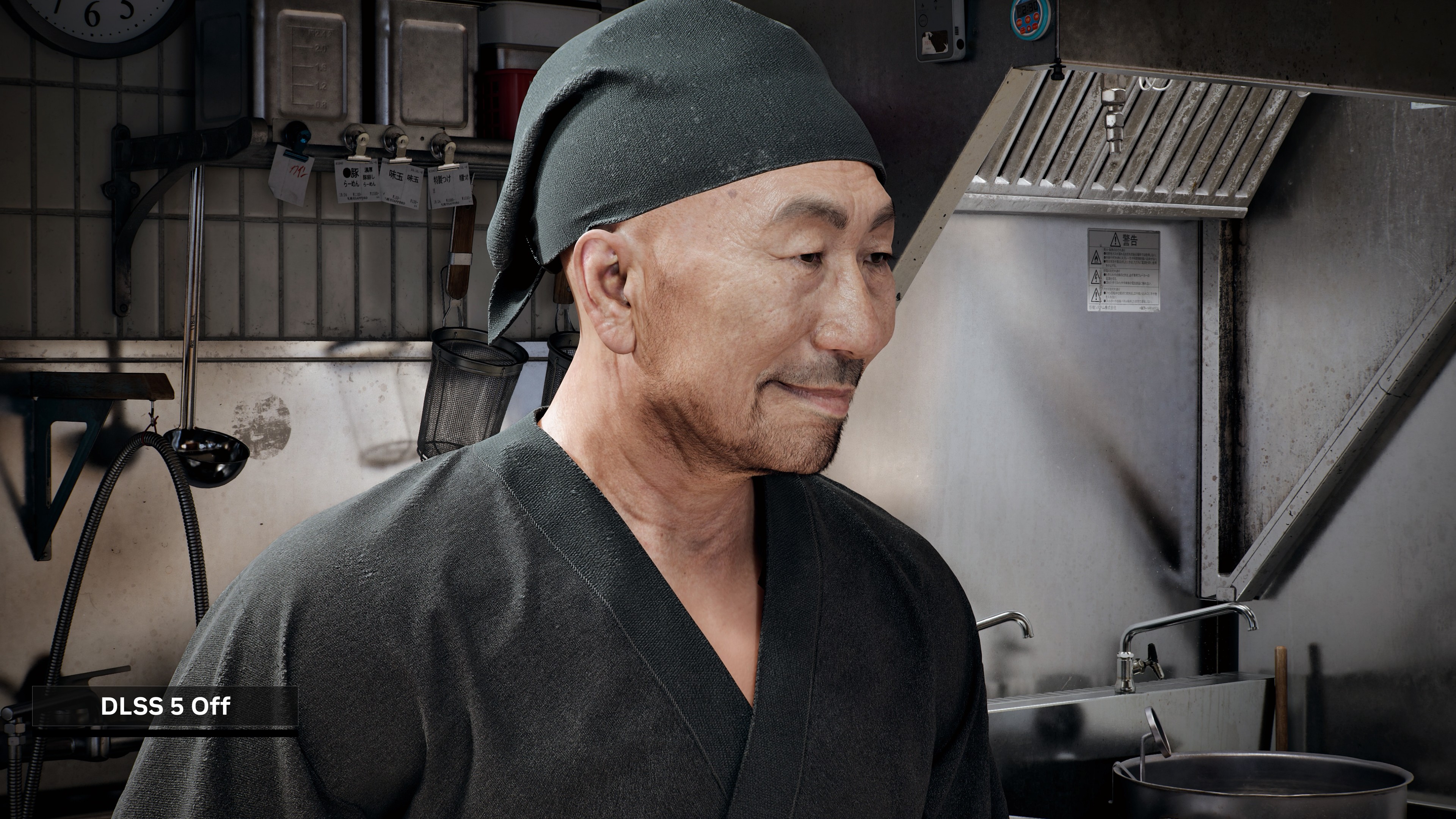
A useful comparison shows both states under the same conditions, then asks what changed in detail, motion stability, lighting, and character identity.

Official ramen chef scene without DLSS 5
ORIGINAL RENDEROFF / BASELINE
Official ramen chef scene with DLSS 5
DLSS 5 RENDERON / NEURAL

Official reference pair · Read the scene, settings, and source before drawing a conclusion · Source: NVIDIA official DLSS 5 technical article

The question behind the question

You are not buying “AI”. You are buying a trade-off.

The decision is not whether the word “AI” sounds impressive. It is whether the final image is worth the cost. Does it recover detail you would otherwise lose? Does it introduce a face, texture, or highlight that was never there? Does the result hold together when the camera moves?

That is why the useful comparison is not a dramatic crop from a showcase video. It is the same scene, same resolution, same settings, with stills, motion, frame time, and latency recorded together. Anything less is marketing material, not a test.

This site is for the person who has to make the setting decision. We will tell you what is officially promised, what has shipped, what independent testing can verify, and where the honest answer is still “we do not know yet”.

The right question is not “does it look more impressive?” It is “what did I give up to get this version of the frame?”

02 / Find the actual change

Which part of the render is being handed to a model?

The important distinction is where DLSS 5 enters the pipeline — and which visual decisions are still made by the game engine versus generated at the end.

01

Scene inputs

Geometry, materials, motion vectors, and rendered pixels.

02

Neural pass

A local model interprets the scene and synthesizes detail.

03

Final frame

Light, surfaces, and character detail arrive on screen.

02.5 / Stop mixing the generations

DLSS 2, 3, 4, and 5 are not the same upgrade.

A lot of bad advice starts by treating every DLSS feature as “make it sharper”. Here is what each generation is actually trying to do.

DLSS 2

Reconstruct the image

Super resolution uses temporal information to produce a sharper image from a lower-resolution render.

DLSS 3

Create an extra frame

Frame generation inserts a generated frame between traditionally rendered frames to improve perceived smoothness.

DLSS 4

Scale generated frames

Multi Frame Generation extends the idea by producing additional frames around a rendered frame.

DLSS 5

Shape the final frame

3D-guided neural rendering moves the discussion toward generated lighting, materials, and surface detail.

03 / Before you change your settings

I bought an RTX 5090. Which games can use this?

A support badge is not enough. Track the game build, required hardware, release status, test coverage, and the caveats that affect the result.

Open the compatibility database
Official NBA 2K27 DLSS 5 scene
NBA 2K27 / DLSS 5Official showcase, not an independent benchmark
01

NBA 2K27

Can I enable it today?

ANNOUNCED
02

Starfield

What build and driver?

ANNOUNCED
03

Resident Evil Requiem

Showcase or real play?

ANNOUNCED
04

Hogwarts Legacy

What does it change?

ANNOUNCED

04 / The part marketing skips

Better image quality can still be the wrong image.

The user pain is not only blur. It is the moment a character looks unfamiliar, a material turns synthetic, or a setting costs more than the visual gain is worth.

THE UPSIDE TO PROVE

  • More convincing light and surfaces
  • Fine detail that survives motion
  • A real improvement at the target resolution

THE FAILURE MODES TO CATCH

  • The art direction starts to drift
  • Plastic, waxy, or over-sharpened detail
  • Extra cost without a stable improvement

04.5 / How not to fool yourself

A comparison is only useful when the conditions are honest.

The easiest way to manufacture a “win” is to change several variables at once. A serious comparison holds the scene, resolution, graphics preset, camera position, driver, and capture method constant. It also includes motion, because a still frame can hide shimmer, crawling detail, and unstable faces.

Every test should answer two separate questions: what did the image gain, and what did the system spend? Record frame time, latency, memory use, and visible artefacts alongside the screenshot. Official showcase footage is useful context, but it is not an independent benchmark.

  • Same scene and camera
  • Same output resolution
  • Still and motion captures
  • Frame time and latency
  • Visible artefacts logged

05 / Make the decision

Before you turn it on, ask these five questions.

01Is DLSS 5 just another upscaler?+

No. The published direction positions it as a 3D-guided neural rendering stage that can generate lighting and material detail from game-engine context.

02Which hardware is supported?+

NVIDIA’s current research and product materials point to GeForce RTX 50 Series support. Requirements should be checked again when each game ships.

03Will every supported game look better?+

Not automatically. Results depend on the game, the art direction, implementation quality, and the settings used for comparison.

04Why does this site separate official and independent evidence?+

Because a product announcement explains intended capability, while an independent test explains what happened in a defined scene and configuration. Both are useful, but they answer different questions.

05What should I look for in a comparison?+

Check fine detail, motion stability, lighting consistency, character faces, material response, frame time, and latency instead of judging a single enlarged screenshot.